
Many woody plants form distinct layers of wood each season that they grow; tree-rings. You have probably seen them in the forest, in the trunks of cut-down trees. Even tiny polar shrubs, although their stems are just millimeters to a few centimters in diameter, form such tree-rings. I find it amazing.
Studying the tree-rings of polar shrubs can tell us how these plants react to warming and extreme weather events in a changing Arctic. This is very useful since many Arctic regions show overall increases in plant growth and shrub expansion, but others don’t. Shrub growth affects the ecosystem through carbon uptake, trapping or redistribution of snow and changes in the microclimate through shading and alteration of air flow near the surface. So the tree-rings can tell us about much more than just the growth of that shrub itself, especially when you study the general growth patterns of many shrubs in the same area over long time periods. Sometimes tree-ring time series extend further back in time than human-measured weather data, so they become proxies (“indicators”) for the climate of the recent past.

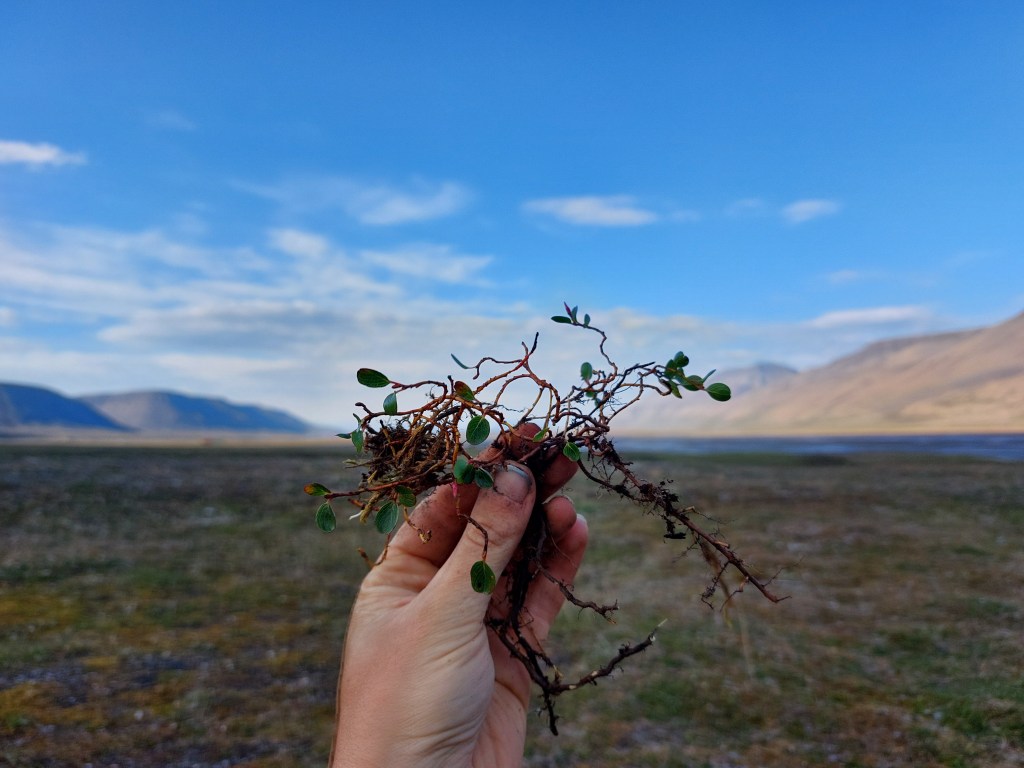
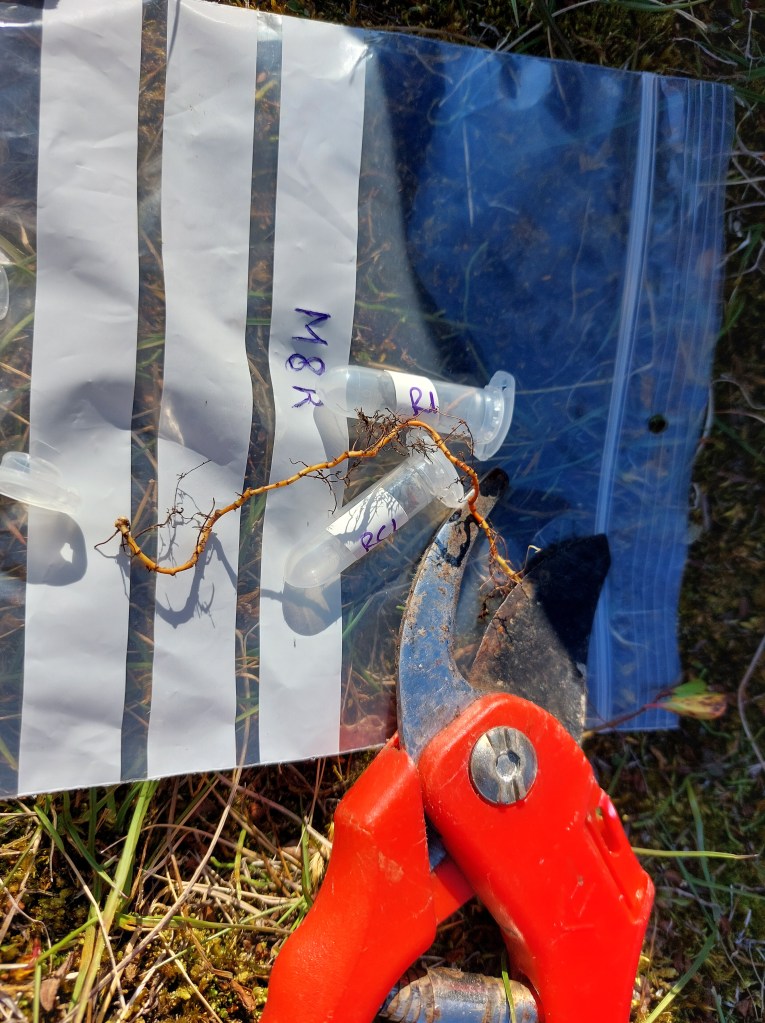
I have started studying tree-rings of Salix polaris, polar willow. Probably one of the most terrible species for tree-ring work, since its rings are extremely small and irregular. I sample my willows from sites where experiments have been carried out that deliberately altered the local climate. For example my own rainfall study, and other sites where temperature, snow depth or nutrient status have been altered for some year. I hope to see how this has affected the growth and properties of the wood compared to unaltered sites. This way, we can assess how future weather extremes may influence shrub growth, carbon uptake and associated ecosystem processes, without having to wait for such an extreme to occur. The tree-rings have effectively stored all those data for us in their own wood! It really is amazing.
So far, the Whispers of the Willows project has collected data from:
- Rainfall & Control sites in the Longyearbyen and Ny-Alesund region (T-REX experiment)
- Snow Fence & Control Sites (Adventdalen)
- Warming, Grubbing, Rain-On-Snow and Control sites (TERRA experiment, Adventdalen
- Scheduled for summer 2026: Warming & Control sites (Ny-Alesund)


 Rúna Magnússon