In a warmer Arctic, plants are expected to expand and grow more biomass. Useful, because this can take up carbon from the atmosphere. At the same time, progressively deeper thaw and destabilziation of permafrost can subject large amounts of previously frozen carbon to decomposition into greenhouse gases. It is hard to assess where the balance lies between carbon uptake through greening, and carbon emission from permafrost. Another interesting complication is the fact that these two mechanisms also affect eachother. Deeper thaw and destabilization affect growth opportunities and availability of water and nutrients for plants. Changes on the surface, such as taller vegetation, more organic soil material or buildup of moss and litter layers, affect the migration of heat from the atmosphere into the soil.
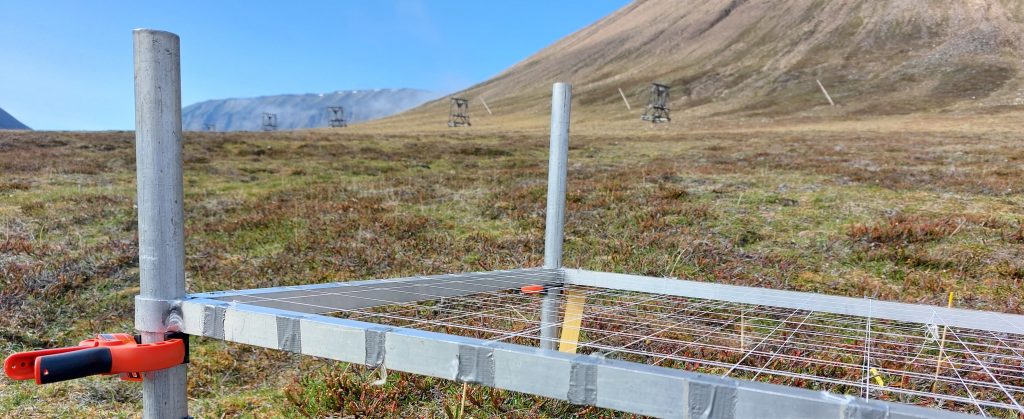
The INSULATE project tries to understand how different types of plants (mosses, lichens, grasses, shrubs) and organic soil properties (root distribution, mycorrhizal and microbial communities, cabron content) control the warming and thawing of permafrost soils.
INSULATE is run by the University Centre in Svalbard, led by Dr. Simone Lang and two PhD candidates. My colleague Juul Limpens and I support the project on behalf of Wageningen University, together with other collaborators from the universities of Bergen, Gothenburg, Copenhagen, NMBU and the Fraunhofer Institute. https://www.unis.no/project/insulate/


Next for the project is to set up lab and common garden experiments to study permafrost thaw under selected plant communities (sods of mosses with different growth structures, bare soils, grass or shrub communities). In the lab, we will also transplant organic soils with different depths and properties onto frozen soil cores to study how this slows down thaw.
Finally, we will develop a list of key above- and belowground biotic properties that colleagues across the Arctic can measure at existing permafrost thaw monitoring sites, so that we can develop a pan-Arctic perspctive on insulation of permafrost soils by plant growth. More to come in the next years!
 Rúna Magnússon